
What is philosophy? It translates as ‘love of wisdom,’ but what does that amount to? How do you love wisdom?
What if we asked instead, What do es philosophy do? Or, what should you do with philosophy?
I find myself wondering: Is philosophy something that can only be done? And to the extent that it is taught, in a university for instance, is it philosophy at all?
If we’re not actively engaged in ‘philosophizing,’ if we are in any respect passively taking notes or trying to pass a test on, say, the constipated and tortured (albeit sometimes insightful, though rarely for the reasons most would think) writing and thinking of, say, Hegel, or Immanuel Kant, or a Heidegger, are we ourselves part of the enterprise of philosophy, or spectators, or something else altogether?
If we are not, in our thinking or our writing, immersed in a methodical inquiry into timely and timeless questions (one of which may be, What constitutes a philosophical question?j, can be said to be doing philosophy? Is this pursuit, when it comes to defining philosophy, wrapping our hearts and minds around it, the essence of what it’s all about? And is much of what it’s become in the academic and scholastic cloister its antithesis, at least as practiced and originated and modeled by the Greeks of old, and many in other parts of the globe as well?
What Socrates did — the exploration of vital concepts as they related to human conduct, with the end of achieving not only greater self understand, but of arete (all-around excellence on individual and collective scales, all roled into one) — was alien to most folks of his day. The idea of not only saying what one thinks, but offering cogent and compelling reasoning to support one’s perspective, was like the arrival of a tsunami — earthshaking, seismic. You either loved it or hated it. Those who embraced it and rose to the occasion It seems to have become pretty alien now, at least to the extent that he engaged with virtually and everyone in the philosophical pursuit, while today it all too often is confined or relegated to certain people and places.
To Socrates, being questioned and challenged and exhorted to develop further one’s thinking by considering a variety of perspectives, examining as thoroughly and thoughtfully as possible what speaks for and against each, was at the heart of ‘loving wisdom’ — the pursuit itself, the active and methodical inquiry, was its embodiment. (The best ever work on philosophic method in general, and the Socratic method in particular, is by the unequalled and lamentably unheralded scholar Justus Buchler — The Concept of Method)
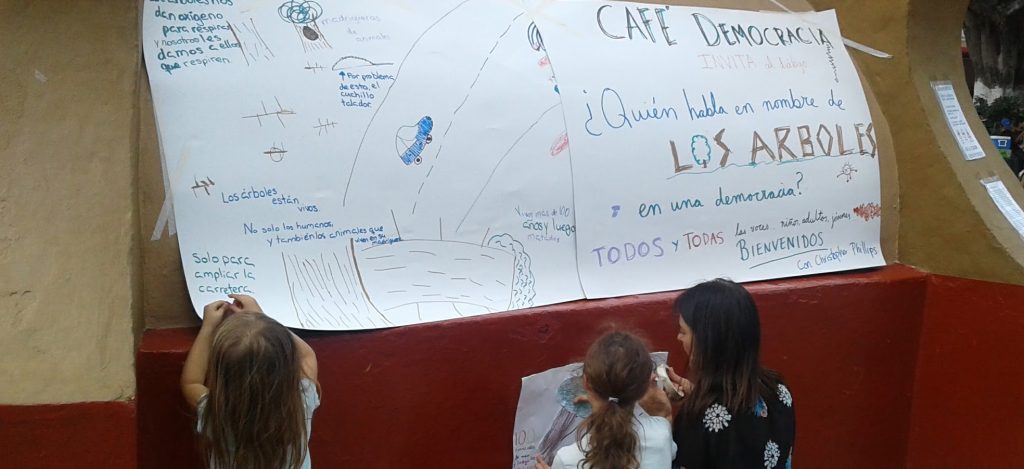
Speaking of love or hate: While I have a PhD, and wrote my dissertation on the Socrates Method, and in particular the version I’ve developed and dissemination over the last twenty years, those in the academic cloister, and those outside of it who consider philosophy primarily an academic exercise, hate what I do. They refer to themselves as the professional philosophers, and to me as a dilettante; they even call what I do ‘a show.’ But there those amazing souls in academia who love the kind of inquiry in which I engage, who consider it at the heart of philosophy, and who do their utmost to make it part of the fabric of their own pursuits both within and without their institutions.
To them as with me, and we are pariahs in most cases, it’s all about the doing rather than the teaching; the doing is the teaching; we are all learning from one another, contributing our stores of wisdom, talents, perspectives, experiences to whatever question we happen to be plumbing. Is that philosophy?
Doing philosophy is a particular and elevated kind of thinking that must be methodical in bent, that must also have an ethos of sympathetic immersion, a sense of all-for-one-and-one-for-alllness, to put it awkwardly. Method does not in any way have to be part of a closed system, but can be the essence of an open system, one that leads to forever new portals, new possibilities for human being, doing, making. At its best, it should make us more and more co-creators of an open universe that makes us more connected, thoughtful, creative, that eliminates divides among the various wisdom traditions and reveals thrilling and surprising matrices. Most of all, it should make us ever more works in progress, sculptures in the making, forever childlike in that sense. If it doesn’t do that to some degree, if it isn’t an active doing and making, a process of being and becoming forever intwined, it may be a meaningful pursuit or activity, but it isn’t philosophy — not by a longshot, by Socrates’ take.